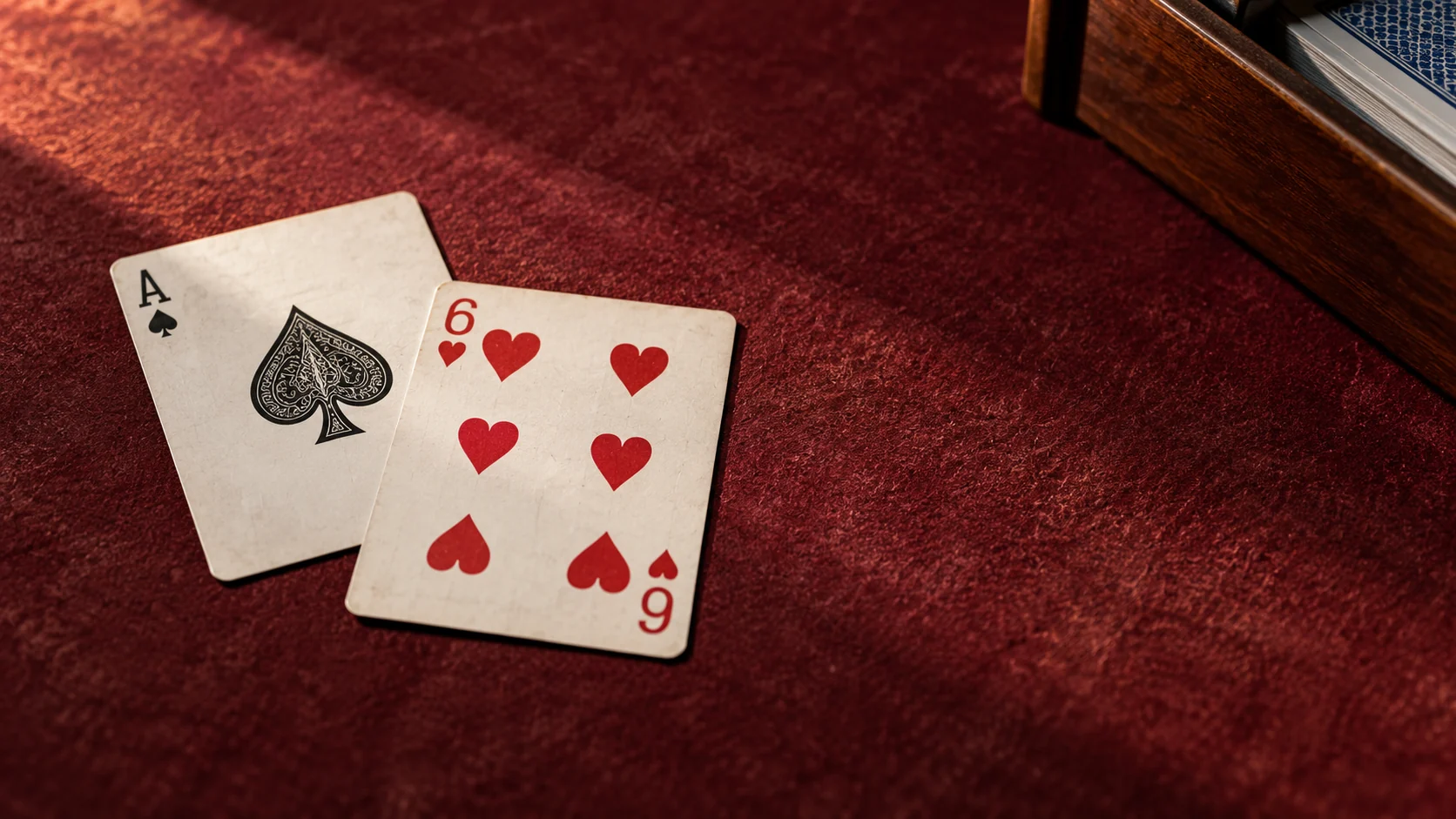
Soft 17 in blackjack is a hand totalling 17 with an ace still counted as 11. Ace–6 is the simplest example. S17 means the dealer stands on soft 17; H17 means the dealer takes another card. Those labels describe the dealer’s compulsory action, not an instruction for the player.
This guide explains how to recognise the hand, read the table rule and avoid confusing a soft total with a hard one. It is a focused companion to our blackjack rules and house-edge guide, rather than a universal strategy chart. The examples use conventional blackjack card values. Always read the rules of the exact game you have opened.
What does soft 17 mean?
In conventional blackjack, an ace can count as either one or eleven. A soft hand uses the eleven value without taking the total above twenty-one. With ace–6, eleven plus six makes seventeen. If a later card would make that interpretation too high, the ace can instead count as one. That flexibility explains the word “soft”.
A hard seventeen has no ace that can currently count as eleven. Ten–7 is hard seventeen. So is ace–6–10: counting the ace as eleven would produce twenty-seven, so it must count as one. The presence of an ace alone does not make a hand soft. Its value in the current total is the deciding detail.
A useful reading method is to count every ace as one initially. Then add ten if doing so keeps the hand at twenty-one or below. If that extra ten is included, one ace is counting as eleven and the hand is soft. You never count two aces as eleven simultaneously in a non-busted conventional blackjack hand.
| Cards | Calculation | Hand type |
|---|---|---|
| Ace–6 | 11 + 6 = 17 | Soft 17 |
| Ace–2–4 | 11 + 2 + 4 = 17 | Soft 17 |
| Ace–Ace–5 | 11 + 1 + 5 = 17 | Soft 17 |
| 10–7 | 10 + 7 = 17 | Hard 17 |
| Ace–6–10 | 1 + 6 + 10 = 17 | Hard 17 |
S17 versus H17: reading the dealer rule
S17 is shorthand for a dealer standing on soft seventeen. H17 means the dealer hits soft seventeen. Under the usual versions of these rules, the dealer stands on hard seventeen in either case. A table description simply saying “dealer stands on 17” is less helpful than wording which explicitly resolves the soft-hand situation.
For an operator-published explanation of this distinction, see 888casino’s soft-17 guide. Its explanation supports the terminology; it should not be read as the rules for every blackjack title available from that brand. A casino lobby can contain games from several suppliers with different settings.
Picture a dealer holding ace–6 after the players have completed their actions. At an S17 table, the dealer’s total stays at seventeen. At an H17 table, another card must be drawn. The dealer does not decide according to how large your bet is, whether you doubled, or how many players remain. The table rule determines the action.
The label is therefore a game condition you check before participating. It is not a setting you change during the round. If the on-screen summary and detailed rules appear inconsistent, ask the operator to identify the applicable rule rather than assuming the version you prefer applies.
What happens when another card is drawn?
Starting from ace–6, drawing a two gives ace–6–2, a soft nineteen. Drawing a four gives soft twenty-one. Drawing a ten gives hard seventeen, because the ace changes to one. These different paths show why “taking a card” does not automatically mean the displayed total increases.
A soft seventeen cannot bust on its very next single card under conventional card values. The starting hand can be read as seven, and the largest value of one added card is ten, making at most seventeen when the ace is reduced. That arithmetic does not mean the hand cannot eventually bust. Further cards can remove the flexibility.
For example, ace–6 followed by an eight becomes hard fifteen. If another ten is then drawn, the total becomes twenty-five. The first draw was protected by the ace’s flexibility; the second was not. Keeping track of whether the current hand is still soft matters more than remembering how the hand began.
Now consider ace–Ace–5. It is soft seventeen because one ace counts as eleven and the other as one. Adding a nine produces sixteen when both aces count as one. The same counting method works even though the original soft seventeen contained three cards rather than two.
Does the player have to follow the dealer?
No. The dealer follows compulsory drawing rules, while the player may have choices such as hitting, standing or doubling, subject to the game. “Dealer stands on all 17s” does not tell a player with ace–6 to stand. Likewise, “dealer hits soft 17” is not a complete explanation of the player’s correct decision.
A player decision depends on the dealer’s visible card and the complete table conditions. A basic-strategy chart is calculated for a defined ruleset. Before relying on one, match the deck count, soft-seventeen rule, doubling restrictions, split rules and surrender availability. A chart without its assumptions is incomplete information.
There is also a difference between knowing a mathematical decision and being able to make it. Doubling may be available only on the first two cards, for example. A three-card soft seventeen could therefore require a different available action from a two-card hand with the same total. The interface and help screen should explain which actions are permitted.
This article deliberately does not attach a hit-or-double instruction to every possible upcard. A short generic table could hide the conditions that make those instructions valid. Understanding the labels first makes it easier to recognise whether a more detailed chart actually belongs to the game you are viewing.
Check the blackjack payout separately
The soft-seventeen rule is only one line in the rules. Another is the payout for a natural blackjack, usually an ace plus a ten-value card in the initial two-card hand. That payout is separate from the usual return for an ordinary winning total.
Here is a simple arithmetic comparison, not a description of a current offer. A £10 winning natural paid at 3:2 produces £15 profit, plus the £10 stake back: £25 returned in total. At 6:5, the same £10 stake produces £12 profit and £22 returned. The difference is £3 on that qualifying winning hand.
That comparison does not say how often blackjack will occur, whether the dealer also has blackjack, or what a whole session will return. It simply translates the payout ratio into pounds. For operator-published discussion of these ratios, see Blackjack and Numbers. Check your table’s own rules for pushes and exceptions.
A twenty-one made with three or more cards should not automatically be treated as a natural blackjack. Nor should you assume an ace and ten after a split receives the natural payout. Those are rule questions. Reading only the large “blackjack pays” lettering can leave important conditions unresolved.
A practical online-table checklist
Before comparing two blackjack games, write their conditions beside each other. Start with the exact game name and supplier so that you can find the same version again. “Classic” or “premium” in a title is not a substitute for the rules.
- Does the dealer hit or stand on soft seventeen?
- What does a natural blackjack pay?
- How many decks are used, and what does the game say about shuffling?
- Which totals can be doubled, and is doubling after splitting allowed?
- How are split aces treated?
- Is surrender offered, and under what conditions?
- How are a dealer blackjack and additional split or double stakes resolved?
- Are side bets governed by separate paytables?
The Gambling Commission’s RTS 3 standard requires applicable game rules to be easily available before customers commit to gamble. Open the help or information panel before placing a stake. A live video stream does not replace the written rules.
Do not merge a side bet’s advertised return with the main blackjack game. They are different wagers with different winning events. Our house-edge comparison guide explains why a percentage needs to be tied to a particular game and set of assumptions.
Common misunderstandings to avoid
“Seventeen is always seventeen.” The numerical total can be the same while the consequences of drawing differ. A ten added to ten–7 busts; a ten added to ace–6 leaves hard seventeen. That is precisely why rule descriptions distinguish soft and hard totals.
“The dealer can choose to help or hurt a player.” In ordinary blackjack, dealer drawing follows the stated rule. A dealer taking a card from soft seventeen at an H17 table is applying that condition, even if an observer expected the dealer to stop.
“One favourable rule makes the whole game favourable.” A single feature does not establish the overall house edge. Payouts and permitted actions also matter. Avoid quoting a low percentage from another game as if it belongs to the one currently open on your screen.
“Knowing the rules guarantees a winning session.” It does not. Correct counting of a hand prevents misunderstandings, but it cannot control the next card. Money committed to gambling can be lost, including over a short run that looks very different from a long-run mathematical average.
Quick answers
Is ace–6 always soft 17?
As a two-card conventional blackjack hand, yes. Once more cards are added, recount the entire hand. Ace–6–10 is hard seventeen; the original ace cannot remain eleven without busting.
Can a soft 17 contain more than two cards?
Yes. Ace–2–4 and ace–Ace–5 are examples. What matters is having an ace counted as eleven in a total of seventeen, not the number of cards.
Does H17 apply to the player?
H17 names the dealer’s rule. It does not remove the player’s available choices or provide a complete strategy for the player’s hand.
Are all UK online blackjack tables identical?
Do not assume so. Use the individual game’s rules to establish its conditions rather than a general statement about a country, operator or game category.
18+. Blackjack is gambling, not a source of income. Set limits before playing and stop if gambling is becoming difficult to control. GamCare offers support.