Roulette bets can look simple, but wheel design has a direct effect on the house advantage. The most useful first check is whether the game uses one zero or two.
This article provides general information, not legal or financial advice. Quvexar does not operate gambling services or link to casino operators.
Single-zero and double-zero wheels
European-style roulette usually has numbers 1–36 plus a single zero. American-style roulette adds 00. Most standard bets pay as if there were only 36 outcomes, so the extra zero increases the mathematical house advantage.
Inside and outside bets
Straight-up numbers, splits, streets and corners are often called inside bets and have less frequent, larger payouts. Red or black, odd or even, dozens and columns are outside bets with more frequent, smaller payouts. They share the same basic house edge on a standard wheel unless a special rule applies.
Special rules may reduce the edge
Rules such as la partage or en prison can alter what happens to even-money bets when zero lands. Read the game help screen to confirm whether such a rule is available and how it is implemented. Do not assume every “European” table uses identical conditions.
Why systems cannot defeat the wheel
Martingale and other progressions rearrange when wins and losses occur; they do not change the chance of the next spin. A sequence can reach table limits or exhaust a budget quickly. Random spins do not compensate for earlier outcomes.
Quick checklist
- Count the zero pockets
- Read special zero rules
- Know the total stake
- Do not chase a sequence
The bottom line
Good decisions begin with verified information and firm personal limits. Check official sources, read the exact rules that apply and remember that no casino game provides a reliable way to make money. If gambling stops feeling manageable, step away and use the support options in our responsible-gambling guide.
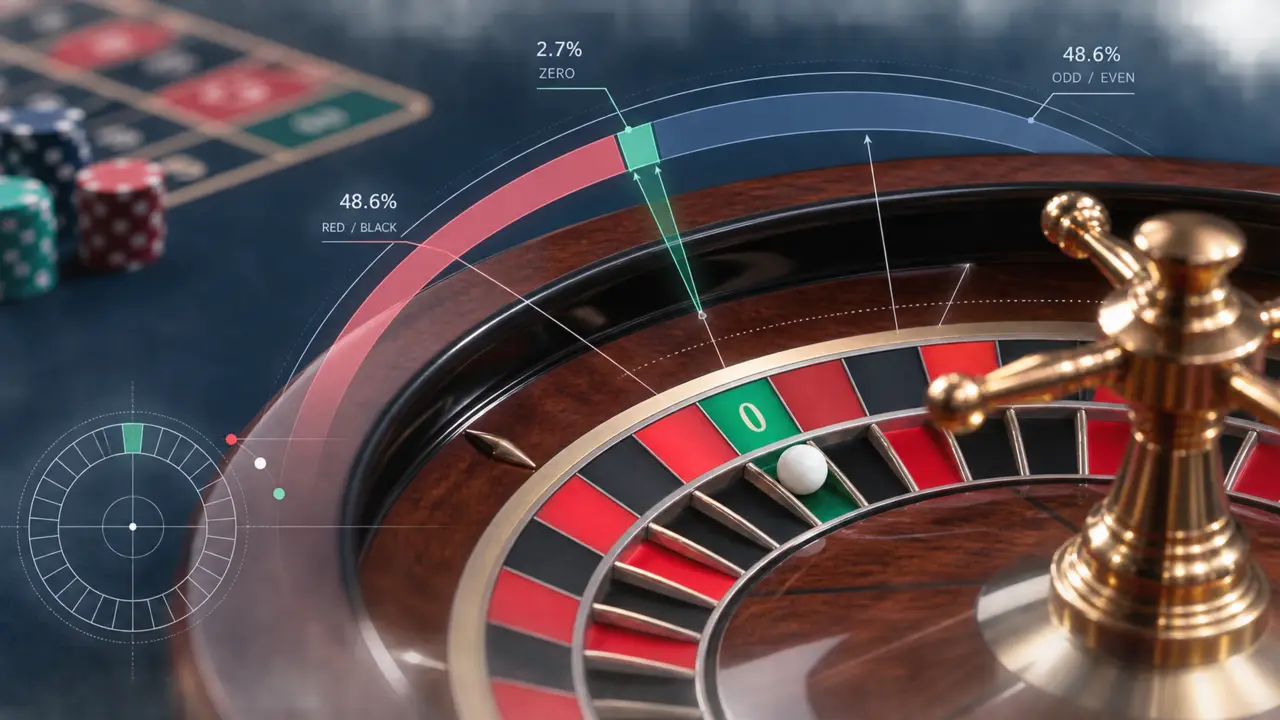
A European roulette wheel has 37 pockets: numbers 1–36 and one green zero. One number wins on 1 of 37 spins, or about 2.70%, and pays 35:1. Red or black covers 18 pockets, wins on about 48.65% of spins and pays 1:1. The green zero creates the standard 2.70% house edge.
European roulette payout and odds table
The figures below apply to a standard single-zero wheel. A 35:1 payout means £35 profit plus the return of the winning £1 stake.
| Bet | Pockets | Payout | Chance |
|---|---|---|---|
| Straight up | 1 | 35:1 | 1/37 = 2.70% |
| Split | 2 | 17:1 | 2/37 = 5.41% |
| Street | 3 | 11:1 | 3/37 = 8.11% |
| Corner | 4 | 8:1 | 4/37 = 10.81% |
| Six line | 6 | 5:1 | 6/37 = 16.22% |
| Dozen or column | 12 | 2:1 | 12/37 = 32.43% |
| Red/black, odd/even, low/high | 18 | 1:1 | 18/37 = 48.65% |
How to calculate roulette odds
Divide the number of winning pockets by the total number of pockets. A corner covers four numbers, so its probability on a European wheel is 4 ÷ 37, approximately 10.81%. A dozen covers 12 numbers, producing 12 ÷ 37, approximately 32.43%.
The advertised payout is lower than mathematically fair odds. One number has 36 losing outcomes for every winning outcome, but the casino pays 35:1 rather than 36:1. That difference produces the house edge.
What are the odds on zero?
On European roulette, zero has exactly the same chance as every individual number: 1 in 37, or approximately 2.70%. On American roulette, zero has a 1 in 38 chance, but there are two green results—0 and 00—so the chance of any green result is 2 in 38, or 5.26%.
Zero is not red or black, odd or even, low or high. A red bet therefore has 18 winning pockets and 19 losing pockets rather than a true fifty-fifty chance.
European and American roulette compared
| Version | Pockets | Green pockets | Standard house edge |
|---|---|---|---|
| European | 37 | 0 | 2.70% |
| American | 38 | 0 and 00 | 5.26% |
The lower edge makes a standard single-zero wheel mathematically preferable when choosing between otherwise comparable versions. It does not make roulette profitable or predictable.
Roulette sectors explained
Sector bets group adjacent pockets on the physical wheel rather than adjacent numbers on the rectangular betting layout. Voisins du Zéro covers the large region around zero; Tiers du Cylindre covers the opposite part of the wheel; Orphelins covers the remaining pockets; and Jeu Zéro covers a smaller group around zero.
A sector is made from several straight, split, trio or corner bets. Check the total chip requirement and paytable because the return depends on which component wins. Sector bets change coverage and staking; they do not predict the next result or remove the house edge.
La partage and en prison
Some single-zero games apply a special rule to even-money wagers when zero lands. Under la partage, half the qualifying stake is returned. En prison may hold the stake for another spin. In the usual implementation, these rules reduce the theoretical edge on qualifying even-money bets to approximately 1.35%.
Do not assume the rule applies because a table is labelled European or French. Open the exact game rules and confirm the treatment of zero before betting.
Why roulette systems do not change the probability
Martingale, Fibonacci and other staking progressions change how much is wagered after a result. They do not change the pocket probabilities, remove zero or make a previous sequence influence the next independent spin. Progressive systems can reach a table limit or exhaust a budget rapidly.
A results history describes earlier spins; it is not a forecast. Five red results do not make black due, and a number that has been absent is not more likely to appear next.
Roulette odds FAQs
What is the probability of one number in European roulette?
It is 1 in 37, approximately 2.70%. A winning straight-up wager normally pays 35:1.
What are the odds of red or black?
Red and black each cover 18 of 37 pockets, so either colour has a probability of approximately 48.65% on a European wheel.
Which roulette version has the lower house edge?
Standard European single-zero roulette has a 2.70% edge, compared with 5.26% on standard American double-zero roulette.
Do sector bets improve the odds?
No. They provide a convenient way to cover neighbouring wheel pockets, but the underlying payouts retain the game's mathematical advantage.
Is zero odd or even?
Neither. Zero is also neither high nor low and is not part of the red or black groups.
Roulette is a game of chance, not an income source. Set a spending limit before play and never chase losses. If gambling stops feeling manageable, visit GamCare or BeGambleAware.